Energy use intensity
Trailing 7 days · 455 Market
48.6kBtu/ft²
−4.2%Led the design of a shared product model for three legacy platforms, preserving operational depth while simplifying how users find their scope and task.
Different products supported control, investigation, and monitoring. The challenge was to bring those workflows together without losing what made each useful.
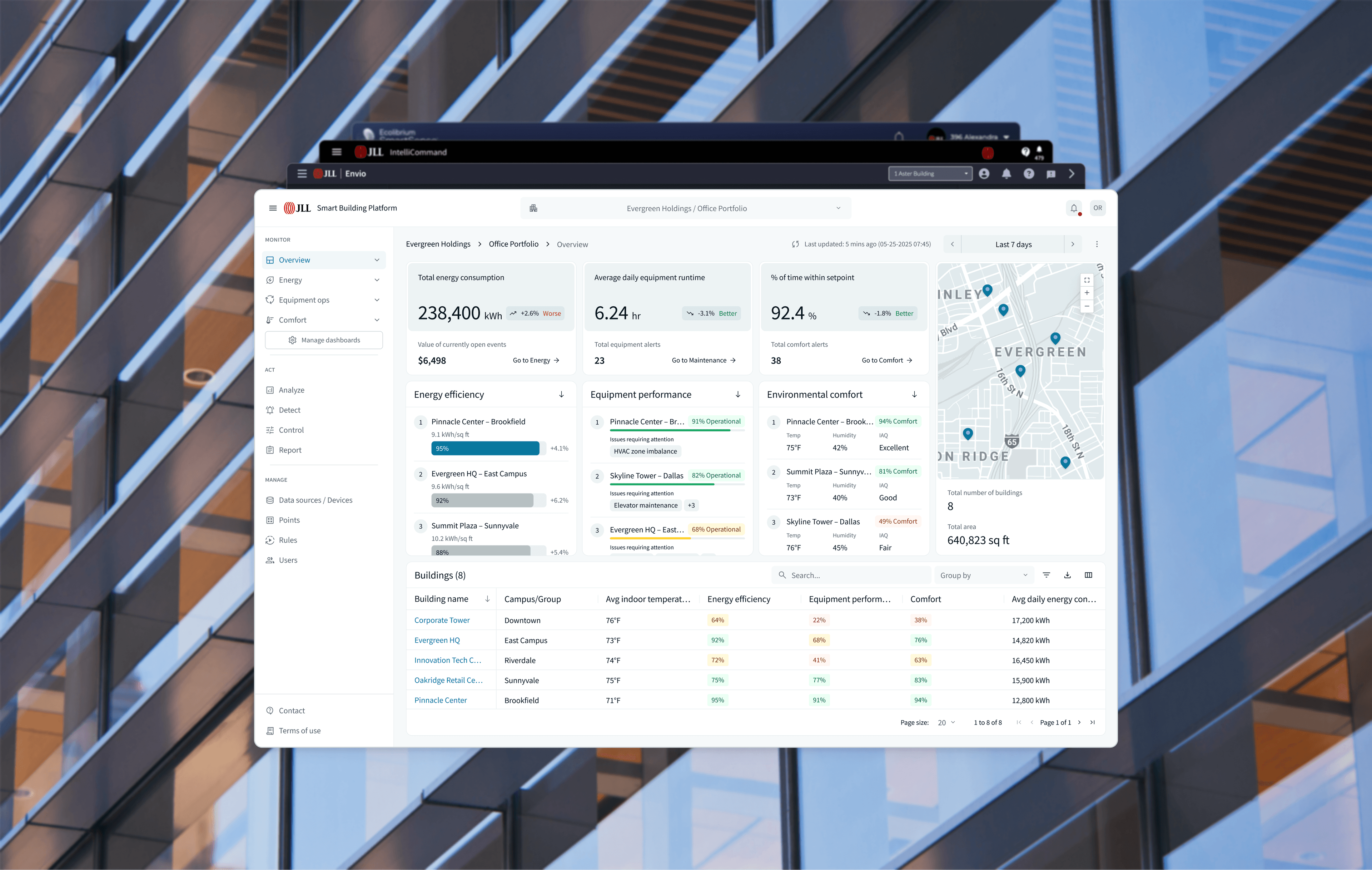
Interviews, observation, and usage data with Product Management revealed two needs: finding the right scope and finding the right capability. I mapped the legacy capabilities into a shared structure around that work.
Scope answers where; intent answers what. I separated these choices so users could start with either. Direct equipment control belongs in Act; defining automatic behavior belongs in Manage.
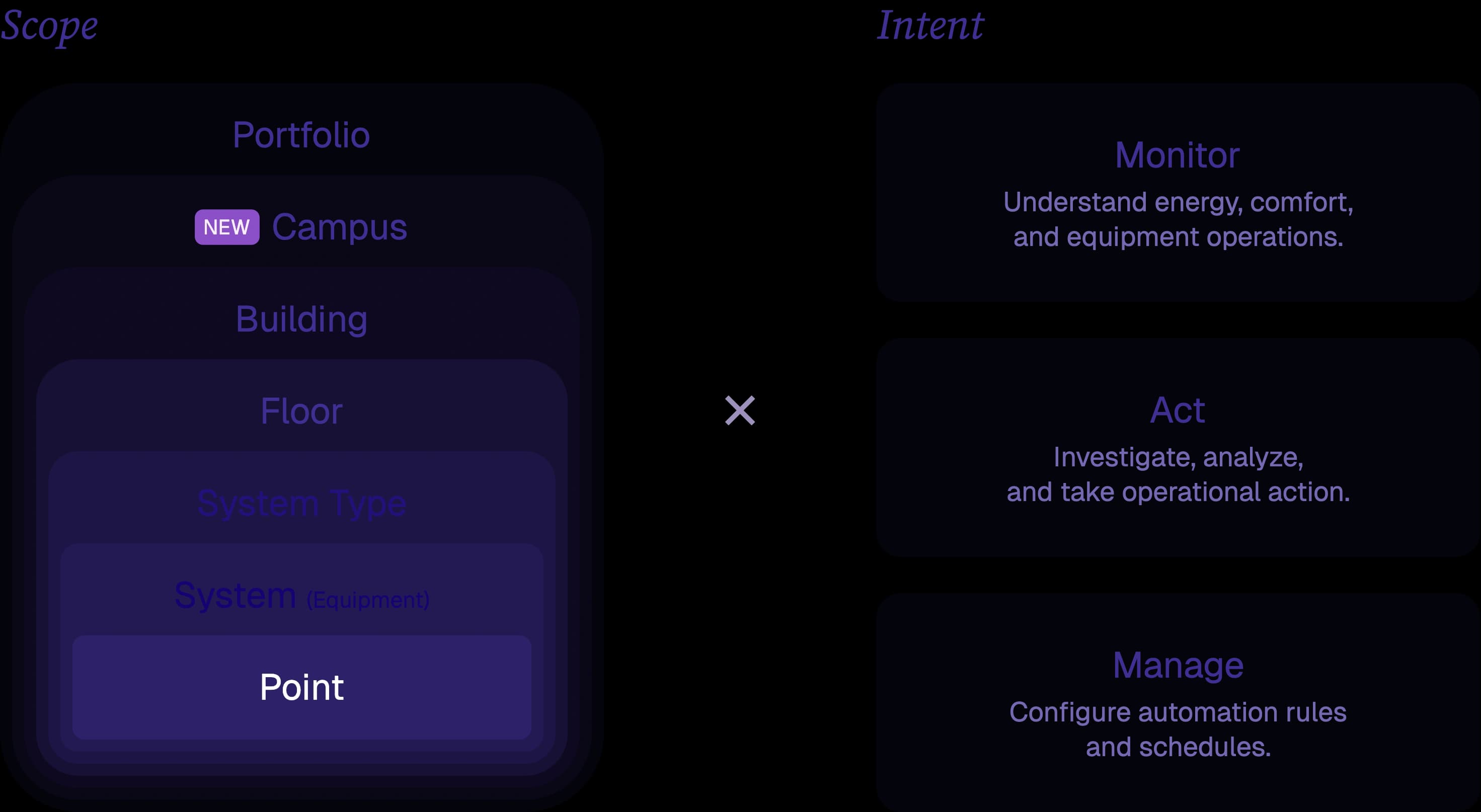
A searchable hierarchy makes the relationship between properties and systems visible. Keeping it separate from task navigation lets users change scope without changing the underlying model.
I carried the model into navigation, workflows, and reusable dashboard widgets with Product, Engineering, Data, and Operations. JLL Design System patterns supported consistent execution across different tasks.
Select a widget to preview the consolidated component set.
Trailing 7 days · 455 Market
48.6kBtu/ft²
−4.2%Today 14:15 PDT
1.84MW
+6.1%Occupied hours · HVAC
92%
+2.8%Showing KPI Metrics.
Modular widgets that carried specialized workflows into one platform.
Design Direction: Provided component guidelines and reviewed other designers’ work to support consistent execution.
Stakeholder Alignment: Aligned product direction with leadership and stakeholders.
Process Improvement: Introduced AI-assisted prototyping and PRD workflows, and added a Design QA step to the development process to maintain design quality. Product and Engineering estimated a 25% improvement in feature delivery from these process changes.
Established a shared structure for three legacy products, connecting property scope, operational tasks, and reusable interface patterns.
30% less time on selected tasks: Observed in limited usability testing comparing the same tasks in the legacy products and SBP 2.0.
Simplifying a platform means clarifying how its capabilities relate while preserving the depth of the work.